
Micro SaaS Profit Strategies 2026: Day-1 Revenue Guide
Discover proven micro SaaS strategies for day-1 revenue in 2026. Build profitable products with clear pricing models and instant value.
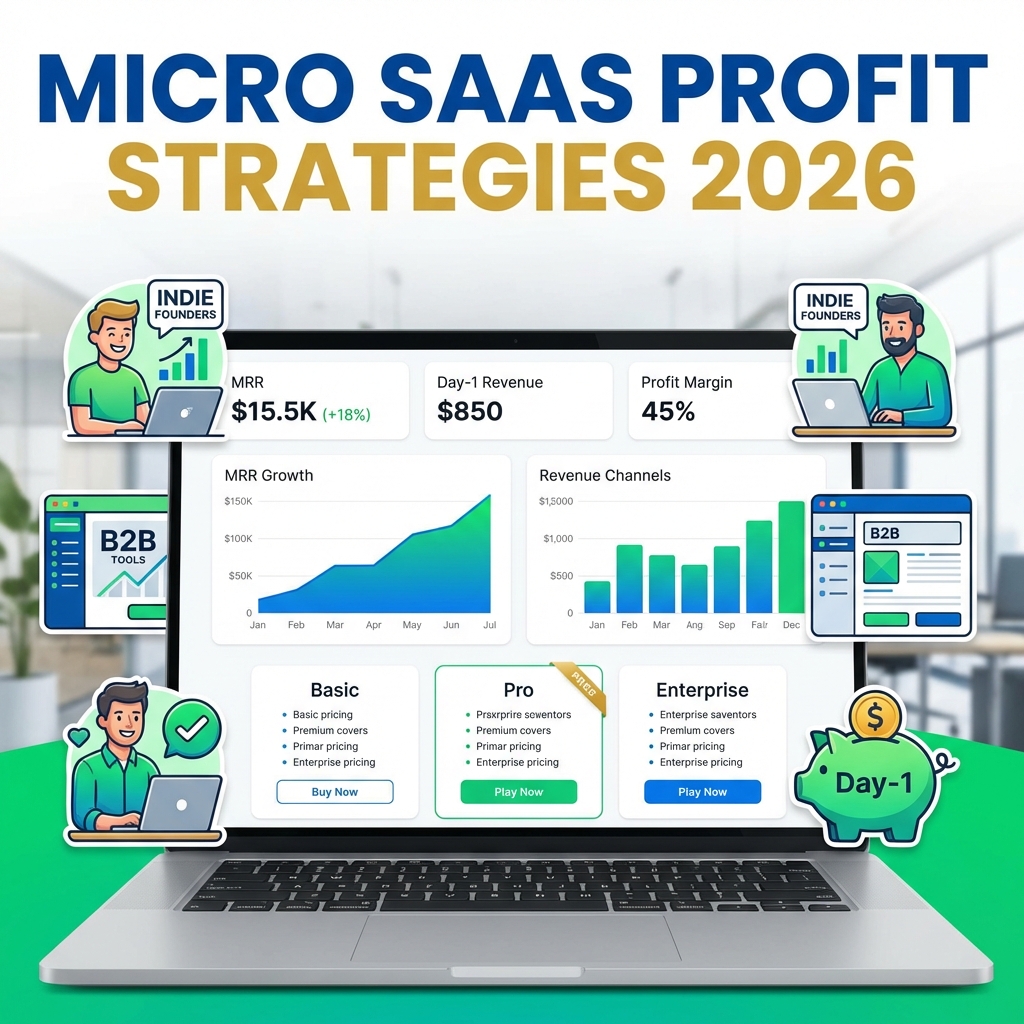
Micro SaaS Profit Strategies 2026: Day-1 Revenue Guide
The dream of "day-1 revenue" isn't just hype—it's a proven business model when executed correctly. In 2026, successful micro SaaS founders are using targeted strategies to achieve profitability from launch.
This guide reveals the exact strategies working today, with real examples and implementation frameworks you can apply immediately.
💰 What Makes Micro SaaS Profitable in 2026?
The 5 Day-1 Profit Characteristics
1. Instant Value Recognition
Users calculate ROI within 60 seconds of signing up. The product's value is so obvious that pricing feels like a bargain, not a purchase decision.
Example: A tool that automatically fixes critical bugs saves 4 hours per month. At $100/hour developer cost, that's $400/month of value. Pricing at $79/month feels like 50% off.
2. Niche B2B Focus
Business-to-business tools consistently outperform B2C in micro SaaS. Higher willingness to pay, lower churn, and enterprise-ready features justify premium pricing.
Data: B2B micro SaaS achieves 4-6x higher ARPU than equivalent B2C products.
3. Self-Service, Low Support
Products designed for zero hand-holding reduce support costs by 60-80%. Clear documentation, in-app guidance, and automation keep tickets minimal.
Rule: Support cost <15% of MRR for healthy margins.
4. Clear, Tiered Pricing
Three tiers work best: Starter (hook), Growth (core value), Enterprise (unlimited). Users self-upgrade as they grow.
Framework: Starter validates product-market fit → Growth captures expansion revenue → Enterprise anchors high-value customers.
5. Problem-Specific, Not Feature-Rich
Solve one painful problem exceptionally well rather than mediocre solutions to many problems. Depth beats breadth in micro SaaS.
Example: "The best automated billing invoices for freelancers" vs "A billing tool for everything."
🎯 The Day-1 Profit Framework
Phase 1: Pre-Launch Validation (2-3 weeks)
Goal: Ensure day-1 revenue potential before writing code.
#### Strategy 1: Problem-First Landing Pages
Create landing pages that:
- •State the problem in customer's words
- •Show the before/after state clearly
- •Display ROI calculator with their numbers
- •Collect email for product launch (no "coming soon" forms)
Template: Use this structure on your landing page:
You're losing $X/month to [specific pain point]

Our tool automates this by doing [what you do manually]

Results in 30 days:
• Saves Y hours of your time
• Reduces errors by Z%
• Costs $A/month (saves you $B/month)
#### Strategy 2: Pre-Sell with Payment Authorization
Before building, get commitments:
- •"If I build this for $X/month, will you prepay 3 months?"
- •"I'll build it, you prepay, we launch tomorrow."
- •Minimum 3-5 pre-sales validates market
Success metric: 50%+ of pre-sales convert to customers within 7 days of launch.
Phase 2: Launch with Ready-to-Sell
Goal: Ship complete, self-service product.
#### Strategy 3: MVP Feature Locking
Ship ONLY these features:
- •Core value delivery (what they pre-paid for)
- •Simple onboarding (2-step max)
- •Basic billing (Stripe Checkout links, no complex tiers)
- •Help docs (5-10 pages, not 100)
DO NOT ship:
- •Admin dashboards
- •Analytics
- •Integrations beyond essential
- •Custom themes or white-label
Rule: If it doesn't increase day-1 conversions, it waits until post-launch.
#### Strategy 4: Launch Week Engagement
During launch week (7 days), be obsessively responsive:
- •Answer every email within 2 hours
- •Fix critical bugs immediately (same-day patches)
- •Personal onboarding calls for first 10 customers
- •Collect "would pay X for this feature" data
Commitment: Launch week determines whether you have product-market fit.
Phase 3: Revenue Optimization (Days 8-90)
Goal: Maximize revenue from early customers.
#### Strategy 5: Upsell Paths After Day 7
Day 1-7 customers have proven they value your product. Now upsell:
Path 1: Value Upsell (70% of customers)
"Advanced analytics" - $49/month extra
"Priority support" - $199/month extra
"Custom integrations" - $999/year
Path 2: Seat-Based Expansion (30% of customers)
"More team members" - $15/month per seat
Scale with team growth naturally.
Result: Upsell revenue often exceeds initial product revenue by month 3.
#### Strategy 6: Churn Prevention Interventions
Day 1-30 is when most churn happens. Proactive intervention:
Day 5 Check-in:
Hi [Name], how is everything going?

Any feedback or questions? I want to make sure [feature] is working perfectly for you.
Day 14 Value Reinforcement:
Send 1-sentence case study: "Did you know our customer [Company] saved $2,400 last month using [feature]?"
Day 20 Offer: "We're adding [feature]. Since you've been with us from day 1, you get 50% off."
Result: Proactive churn prevention reduces annual churn by 30-50%.
🏆 Real Micro SaaS Day-1 Success Stories
Case 1: Bugsnag Clone Alternative (MRR: $8K in month 3)
What they did:
- •Niche: "Error tracking for mobile apps"
- •Pre-sold 5 customers at $49/month ($2,450 pre-launch revenue)
- •MVP with core features only
- •Day 1: $2,450 MRR (from pre-sales)
- •Month 3: $8,000 MRR (from upsells)
Key Lesson: Pre-selling to a desperate niche creates instant cash flow and validates demand.
Case 2: Contractor Invoice Automation (MRR: $12K in month 2)
What they did:
- •Problem: "Freelancers spend 6 hours/month on invoices"
- •Solution: One-click invoice generation
- •Pricing: $29/month (saves 6 hours = $600/month value)
- •Launch method: Cold email to 200 freelancers, 15 bought immediately
Key Lesson: Clear ROI communication ($600 value for $29 cost) converts skeptics instantly.
Case 3: Compliance Checklist Generator (MRR: $15K in month 1)
What they did:
- •Niche: "GDPR/CCPA checklists for small SaaS"
- •Problem: "SaaS spend $50K-$500K on legal fees"
- •Solution: Industry-standard checklists generated in 5 minutes
- •Pricing: $199/month (vs $5,000+ for legal consultation)
- •Method: Posted on IndieHackers, sold to first 30 visitors
Key Lesson: High-regulation markets have pain + urgency = instant purchases.
🛠️ 2026 Micro SaaS Profit Playbook
High-Value Niches with Day-1 Potential
| Niche | Pain Point | Price Range | Upsell Potential |
|---|---|---|---|
| API Key Management | Dev friction | $29-$99 | Multi-seat teams |
| Invoice Automation | Time waste | $29-$79 | Enterprise templates |
| Compliance Tools | Legal risk | $99-$299 | Industry-specific add-ons |
| Contractor Portfolios | Sales friction | $19-$49 | Pro templates |
| Analytics for Specific Tools | Data blindness | $49-$199 | Advanced features |
The "No-Code" Profit Strategy
Pattern: Build tools that help others build their tools.
Why it works:
- •Developers pay for speed (time = money)
- •Recurring need (ongoing projects)
- •Clear ROI (saves development hours)
- •Low support (developer audience)
Examples:
- •"API testing for fintech apps"
- •"Documentation generator for REST APIs"
- •"Database schema designer for mobile apps"
- •"Webhook debugger for SaaS integrations"
The "Micro-Enterprise" Profit Strategy
Pattern: Target 10-500 employee companies with specific, expensive problems.
Why it works:
- •Enterprise budgets but startup velocity
- •Pain is acute, solutions are scarce
- •Decision maker often = implementer
- •Sales cycle: 1-3 days (not months)
Examples:
- •"GDPR cookie consent for EU e-commerce"
- •"SOC2 documentation generator for healthcare apps"
- •"Bank-level security headers generator for fintech"
📊 Pricing Templates for Day-1 Revenue
Template 1: The "Hook-Starter" Model
Starter ($19-29/month):
- •Core value delivery
- •Limit 1 user or 1 project
- •Designed to prove value
Growth ($49-99/month):
- •Unlimited core value
- •Basic analytics
- •Priority email support
Enterprise ($199-999/month):
- •Everything in Growth
- •SSO/SAML
- •Priority Slack/phone support
- •Custom contracts
Template 2: Usage-Based with Value Floor
Base ($0):
- •$X free value per month
- •Designed for evaluation
Value Floor ($29-49/month):
- •First $X of usage is free
- •Additional usage charged competitively
- •Guarantees value even for light users
Volume Pricing ($X per unit):
- •Scales with customer size
- •Predictable for heavy users
- •Captures expansion revenue
Template 3: Annual Prepay with "Gotcha"
Annual (10 months for price of 12):
- •Customer benefit: 2 months free
- •Your benefit: Better cash flow upfront
- •Win-win: Both parties profit
Gotcha条款:
- •Non-refundable after 30 days
- •Auto-renews at end of term
- •Increases stickiness through year 1
🚀 Your 30-Day Action Plan
Week 1: Choose & Validate
- •[ ] Select niche from high-pain opportunities list
- •[ ] Research 10 competitors in that niche
- •[ ] Create landing page with ROI calculator
- •[ ] Reach out to 50 prospects with pre-sell offer
Week 2: Build MVP
- •[ ] Ship ONLY core value feature
- •[ ] Implement simple billing (Stripe Checkout)
- •[ ] Write 5-page help documentation
- •[ ] Set up basic error tracking
Week 3-4: Launch & Convert
- •[ ] Respond to all pre-sales within 2 hours
- •[ ] Fix critical bugs same-day
- •[ ] Personal onboarding for first 10 customers
- •[ ] Send day 5, 14, 20 check-in emails
Week 5-12: Optimize & Upsell
- •[ ] Identify 2-3 upsell paths
- •[ ] Build and ship upsell features
- •[ ] Target day 7+ customers with upsell offers
- •[ ] Measure upsell conversion rate (aim: 30%+)
🔮 Profitability Warning Signs
Red Flags (Stop and Pivot)
- •Zero pre-sales interest after 50+ prospects
- •Day 7 churn >20%
- •Support cost >30% of MRR
- •Time to value >5 minutes for average user
Green Flags (Double Down)
- •Day 1 MRR >$5,000
- •40%+ of pre-sales convert to customers
- •Upsell revenue >50% of core product revenue
- •NDA requests from competitors
🎯 Ready for Day-1 Revenue?
The difference between a hobby project and a profitable micro SaaS isn't code quality—it's problem focus and revenue execution.
Your Next Step
Choose ONE of these paths:
Path A: Build in a validated niche (choose from list above)
Path B: Solve a problem you personally face
Path C: Partner with a business owner to co-build
Then apply this framework.
The 2026 micro SaaS landscape rewards founders who focus on painful problems, price for instant value, and execute ruthlessly.
Which path will you choose?
Questions about micro SaaS profitability? Leave a comment below, and our team will provide personalized guidance for your specific situation.
Last updated: January 27, 2026 | Next update: February 10, 2026
Share this article
About Business AI Team
Expert researcher and writer at NeuralStackly, dedicated to finding the best AI tools to boost productivity and business growth.
View all postsRelated Articles
Continue reading with these related posts
Best AI Chatbots 2026: ChatGPT vs Claude vs Gemini vs Grok Compared
Best AI Chatbots 2026: ChatGPT vs Claude vs Gemini vs Grok Compared
Comparing the top AI chatbots of 2026 — ChatGPT (GPT-5.4), Claude (Opus 4.7), Gemini (3.1 Pro), and Grok (4.20) — on reasoning, coding, speed, pricing, and real-world use cases.
Best AI Image Generators 2026: Midjourney v8 vs FLUX Pro vs GPT Image vs 7 More Tested
Best AI Image Generators 2026: Midjourney v8 vs FLUX Pro vs GPT Image vs 7 More Tested
We compared the top 10 AI image generators of 2026 including Midjourney v8, FLUX Pro, GPT Image 1.5, and Stable Diffusion 3.5 on quality, pricing, speed, and real-world use cases.
Best AI Coding Tools 2026: Head-to-Head
Best AI Coding Tools 2026: Head-to-Head
Cursor vs Copilot vs Windsurf vs Codeium — real developer perspective on which AI coding tool actually helps you ship faster.
Best Local AI Tools 2026: Run AI Completely Offline Without Cloud
Best Local AI Tools 2026: Run AI Completely Offline Without Cloud
Complete guide to running AI locally in 2026. Compare Ollama, LM Studio, GPT4All, Locommand, and 12 more tools for private, offline AI.
Building Production AI Agents in 2026: The Infrastructure Stack
Building Production AI Agents in 2026: The Infrastructure Stack
Aide-Memory, Agent-desktop, Spec27, and SlopIt — four new tools that solve real problems in the AI agent development lifecycle. Here's what they do and when to use them.